 Medically ReviewedDr. Manish DubeyUrologist Medically ReviewedDr. Manish Dubey
Dr. Manish Dubey, Director and Consultant Urologist at MITR Hospital, Kharghar, has 20+ years in onco-urology and robotic and laparoscopic urology.
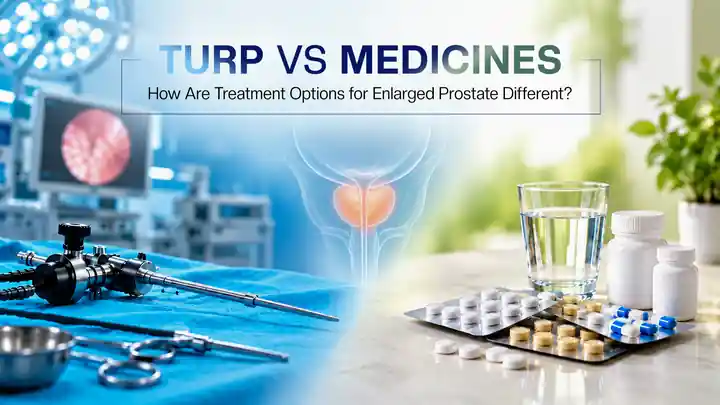
View doctor profileIf an enlarged prostate is causing problems such as a weak urine stream, frequent urination or difficulty emptying the bladder, treatment may include medicines or a procedure such as TURP surgery. The right approach depends on how severe your symptoms are, how much they affect your daily life, the size and characteristics of the prostate, and how well you respond to treatment.
Understanding the difference between TURP and medication for an enlarged prostate can help you have a more informed discussion with your urologist.
How Do Medicines Treat an Enlarged Prostate?
Medicines aim to improve urinary symptoms without removing prostate tissue.
Alpha-blockers, such as tamsulosin, relax the muscles around the prostate and bladder neck. This can make it easier for urine to pass and may improve symptoms relatively quickly.
Another group, 5-alpha reductase inhibitors, such as finasteride and dutasteride, work differently. These medicines reduce the effect of a hormone involved in prostate growth and can gradually reduce prostate size. They are generally considered when the prostate is enlarged and there is a risk of the condition progressing. Finasteride and dutasteride take months, often 3–6, to show benefit. They also roughly halve PSA values, which matters for later PSA testing.
Some patients may also be prescribed a combination of medicines when a single medicine does not provide enough relief.
Medicines can be useful when symptoms are manageable and there is no immediate need for a procedure. However, they need to be taken regularly and may cause side effects. Alpha-blockers may cause dizziness or low blood pressure on standing, and may cause ejaculatory changes. 5-alpha reductase inhibitors cause reduced libido or erectile changes. Patients on tamsulosin should tell their eye surgeon before cataract surgery (floppy iris syndrome).
The choice of medicine depends on your symptoms, prostate size, other health conditions and the medicines you already take.
What Is TURP Surgery?
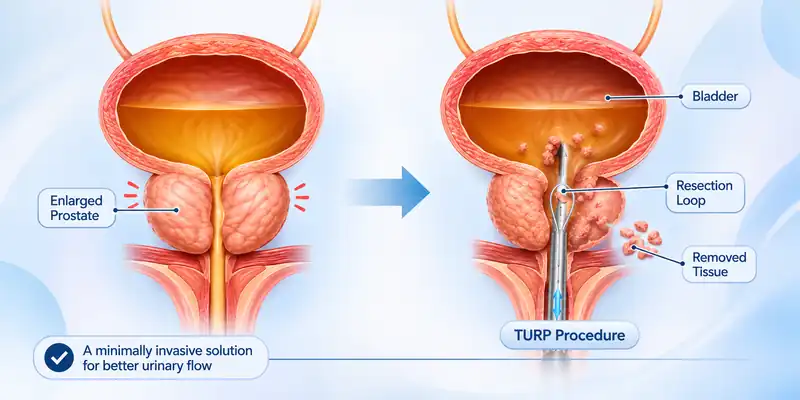
TURP, or transurethral resection of the prostate, is a procedure used to remove prostate tissue that is obstructing the flow of urine.
During TURP, a thin surgical instrument is passed through the urethra, so there is no external incision. The surgeon removes the part of the prostate that is blocking urine flow, creating more space for urine to pass.
Unlike medicines, which manage the effects of prostate enlargement, TURP physically removes the obstructing tissue. It may therefore be considered when urinary symptoms such as urinary retention, recurrent UTIs, bladder stones, recurrent bleeding from the prostate or kidney impairment due to obstruction remain troublesome despite medicines or when the prostate obstruction is causing significant problems.
MITR Hospital routinely does TURP among its various endoscopic urological procedures.
What About Recovery After TURP?
Because TURP involves removing obstructing prostate tissue, it requires a period of recovery that medicines do not.
After the procedure, a urinary catheter is commonly used temporarily while the urinary system recovers. You may experience some urinary discomfort or changes in urine flow during the early recovery period. Your urologist will advise you when it is safe to return to exercise, heavy lifting and other normal activities.
The exact recovery period varies between patients and depends on the procedure and overall health.
TURP vs Medicines: What Is the Difference?
The main difference is how each treatment addresses the problem.
| Medicines | TURP surgery | |
|---|---|---|
| How it works | Relaxes prostate/bladder muscles or reduces prostate growth, depending on the medicine | Removes prostate tissue causing obstruction |
| Treatment type | Non-surgical | Minimally invasive procedure |
| How long? | Usually needs prolonged treatment | Treats the existing obstruction during the procedure |
| When considered | Depends on symptoms, prostate size and individual factors | May be considered when medicines are not able to manage symptoms or obstruction is significant |
| Recovery | Slow | Requires a period of recovery after the procedure |
| Anesthesia | No | Requires anesthesia for surgery |
| Side effects | Depend on the medicine used | Risks are related to the procedure and should be discussed beforehand |
The decision is not simply about choosing between a tablet and surgery. Your urologist will consider the underlying cause of your symptoms, prostate size, urinary flow, bladder emptying and how much the symptoms are affecting you.
When Might Medicines Be Considered?
Medicines may be appropriate when symptoms are bothersome but can be managed without a procedure. They may also be used before considering surgery, depending on the individual case.
If symptoms improve and remain controlled, ongoing medical treatment may be all that is needed. If symptoms continue despite treatment, become more troublesome or are associated with complications, your urologist may discuss procedural options.
When Might TURP Be Considered?
TURP may be considered when medicines do not provide adequate relief or when prostate enlargement is causing significant obstruction.
The need for a procedure may also depend on problems such as difficulty emptying the bladder or repeated urinary complications. The decision should be based on an assessment of the individual patient rather than symptoms alone.
It is also worth remembering that TURP is not the only procedure available for an enlarged prostate. Depending on the prostate and the patient’s condition, other minimally invasive approaches may be considered.
What About Recovery After TURP?
Because TURP involves removing obstructing prostate tissue, it requires a period of recovery that medicines do not.
After the procedure, a urinary catheter is commonly used temporarily while the urinary system recovers. You may experience some urinary discomfort or changes in urine flow during the early recovery period. Your urologist will advise you when it is safe to return to exercise, heavy lifting and other normal activities.
The exact recovery period varies between patients and depends on the procedure and overall health.
How Is the Right Treatment Chosen?
There is no single treatment that is right for every man with an enlarged prostate.
Your urologist may consider your symptoms, prostate size, urinary flow, bladder emptying, other medical conditions and previous treatment before recommending medicines or a procedure.
The aim is to relieve troublesome symptoms while choosing an approach that is appropriate for your condition.
Enlarged Prostate Treatment at MITR Hospital, Kharghar
At MITR Hospital, Kharghar, the Urology and Andrology team provides diagnosis and treatment for prostate enlargement. The hospital has facilities including uroflowmetry, ultrasound and urodynamic studies, which can help assess urinary flow and bladder function.
For patients who require a procedure, MITR hospital offers TURP surgery among its endoscopic urological procedures and also provides laser-based urological treatment for selected conditions.
Whether medicines or a procedure is more appropriate depends on the individual patient. A urological assessment can help determine what is causing the symptoms and which treatment approach is most suitable.
FAQs on TURP and Medicines
Was this Blog helpful?
Thank you for your feedback!