 Medically ReviewedDr. Manish DubeyUrologist Medically ReviewedDr. Manish Dubey
Dr. Manish Dubey is Director and Consultant Urologist at MITR Hospital, Kharghar, Navi Mumbai, with over 20 years of experience in onco-urology, reconstructive urethral surgery and robotic and laparoscopic urology.
Read more →Before we get into treatments and why some cases go straight to surgery, let’s start with the basics: what exactly is PCNL (Percutaneous Nephrolithotomy)?
PCNL is a keyhole procedure used to remove large or complex kidney stones through a small tract in the back. In this blog, we’ll walk you through how it works, when it’s needed, and what recovery looks like, so everything you need to know is right here.
Table of Contents
- What is PCNL and How Are Kidney Stones Cleared by PCNL?
- What is PCNL Surgery?
- When is PCNL Recommended?
- How Are Kidney Stones Cleared by PCNL? (Step-by-Step)
- Key Benefits of PCNL Surgery
- Why PCNL is More Effective Than Other Treatments for Big Stones?
- Types of PCNL Techniques
- Recovery After PCNL Surgery
- Why Some Cases Skip Straight to PCNL Surgery?
- When is PCNL not Done? What are the Complications Which can Occur After PCNL?
- Modern PCNL Isn't What It Used to Be
- The Takeaway
- Meet Our Urology Specialists
- Frequently Asked Questions
What is PCNL and How Are Kidney Stones Cleared by PCNL?
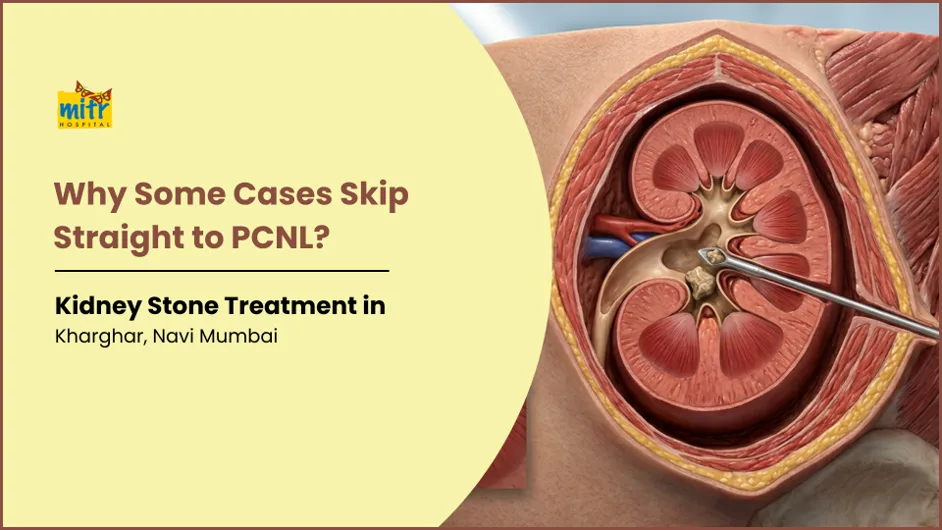
PCNL (Percutaneous Nephrolithotomy) is a minimally invasive kidney stone surgery in which the urologist removes the stone through a small keyhole tract, about 1 cm wide, created in the back.
Why it works well
- It gives direct access to the kidney, so even large or complex stones can be treated effectively.
- It is the gold-standard treatment for big kidney stones.
- Stone clearance is often achieved in a single sitting, something gentler methods like ESWL often cannot do reliably.
What the evidence shows
- In the largest real-world study (CROES, nearly 6,000 patients), 85% needed no additional treatment after PCNL.
- The stone-free rate at 30 days was 75.7%.
- Staghorn stones in particular sometimes need a second-look procedure.
Reference: PCNL’s status as gold-standard procedure affirmed by study, Urology Times
What is PCNL Surgery?
- PCNL full form: Percutaneous Nephrolithotomy, where percutaneous means “through the skin” and nephrolithotomy means “removal of a kidney stone.”
- Minimally invasive technique: Only a small incision (about 1 cm) is made in the back, instead of the large cut used in traditional open kidney stone surgery.
- Direct kidney access: A narrow tunnel (tract) gives the urologist a clear, direct route to the stone inside the kidney.
- Performed under anaesthesia: The procedure is done under general or regional anaesthesia, so you feel no pain during surgery.
When is PCNL Recommended?
- Large kidney stones: Usually stones larger than 2 cm (20 mm).
- Complex or staghorn stones: Stones that fill much of the kidney’s collecting system.
- Failed previous treatment: When ESWL (shockwave lithotripsy) or RIRS (laser surgery) has not cleared the stones.
- Hard stones: Stones resistant to shockwaves, such as cystine or calcium oxalate monohydrate stones.
- Anatomical problems: Conditions such as a blocked ureter or abnormal kidney structure that make other methods unsuitable.
In short, PCNL is generally the treatment of choice when a kidney stone is too large, too complex, or too hard to be cleared by less invasive options like ESWL or RIRS. Because it removes the stone directly through a small incision in the back, it offers a high chance of clearing the stone in a single procedure. The final decision depends on the size, location, and type of stone, as well as your overall health and kidney anatomy, so a urologist should evaluate your scans and medical history before recommending the best approach.
How Are Kidney Stones Cleared by PCNL? (Step-by-Step)
- Anaesthesia and positioning: The patient is given anaesthesia and positioned, usually lying face down or in a prone position.
- Creating the tract: Using X-ray (fluoroscopy) or ultrasound guidance, the urologist makes a small puncture in the back and creates a narrow tract into the kidney.
- Inserting the nephroscope: A thin telescope called a nephroscope is passed through the tract to view the stone directly.
- Breaking the stone: The stone is fragmented using laser or pneumatic lithotripsy energy.
- Removing the fragments: The broken pieces are suctioned out or extracted with special graspers and baskets.
- Final check: The kidney is examined to confirm that the stone is completely cleared.
- Drainage: A small tube (nephrostomy tube or DJ stent) may be placed temporarily to help the kidney drain and heal.
Key Benefits of PCNL Surgery
- High stone-free rate: Excellent success in clearing large and complex stones.
- Single-sitting clearance: Often removes the entire stone burden in one procedure.
- Small incision, less pain: Compared with open surgery, there is less scarring and blood loss.
- Shorter hospital stay: Most patients go home within 1 to 3 days.
- Faster recovery: Patients can usually return to normal activities within 1 to 2 weeks.
- Lower chance of repeat procedures: Fewer sessions are needed compared with other stone treatments.
Why PCNL is More Effective Than Other Treatments for Big Stones?
- ESWL (shockwave lithotripsy): Works well for small stones but often needs repeated sessions for large ones.
- RIRS (retrograde intrarenal surgery): Ideal for small to medium stones, but may need staged procedures for large stone burdens.
- PCNL: Provides the most direct access, allowing complete clearance of big and complex stones.
Types of PCNL Techniques
- Standard PCNL: Uses a larger tract, suited for very large stones.
- Mini PCNL: Uses a smaller tract, with less bleeding and quicker recovery.
- Supine PCNL: Performed with the patient lying on their back, often more comfortable for the anaesthetist.
Recovery After PCNL Surgery
- Mild back discomfort and slight blood in the urine for a few days are common.
- Drink plenty of water to help flush the kidney.
- Avoid heavy lifting and strenuous activity for 1 to 2 weeks.
- Attend follow-up visits and imaging to confirm complete stone clearance.
Why Some Cases Skip Straight to PCNL Surgery?
The stone is simply too large. Stones over 2 cm, and especially “staghorn” stones that fill the kidney’s collecting system, rarely clear with shock waves or a laser scope alone. Going straight to PCNL surgery avoids multiple failed procedures and repeated anesthesia.
The stone is very hard. Some stones (like calcium oxalate monohydrate) barely respond to shock waves. Attempting ESWL first would just delay the real treatment.
There’s an infected, obstructed kidney. This is a medical emergency. Waiting to “try something less invasive first” risks permanent kidney damage.
Anatomy makes other routes difficult. A narrow or unusually shaped ureter can make it hard to pass a scope up to the kidney, making PCNL surgery the more reliable path.
Previous treatments have failed. If ESWL or laser ureteroscopy already left significant fragments behind, PCNL surgery is often the fastest way to finish the job rather than repeating a method that hasn’t worked.
When is PCNL not Done? What are the Complications Which can Occur After PCNL?
PCNL is a safe and highly effective option for most patients with large or complex kidney stones, and with the right planning, the vast majority do very well. Before surgery, your urologist checks a few things, such as any active urine infection, blood-thinning medicines, heart or lung health, and blood pressure or sugar levels, so the procedure can be done at the safest possible time. In some cases, PCNL may be postponed for a short while until these are well controlled, and this is done only to protect you and improve the results.
Possible complications after PCNL include mild blood in the urine, slight back discomfort or a temporary fever. These are usually short-lived and easily managed, and serious complications are uncommon when the surgery is done by an experienced urologist. Your urologist will also explain the warning signs to watch for during recovery and when to call your doctor, so you feel confident and well prepared at every step.
Contraindications of PCNL
- Untreated urine infection/ urosepsis
- Uncorrected bleeding disorder, or blood thinners that can’t be stopped.
- Pregnancy.
- A suspected kidney tumour.
Modern PCNL Isn't What It Used to Be
Today’s mini-PCNL uses narrower instruments than older techniques – smaller tract, less bleeding, less pain, and the patient is often discharged the next-day. Modern PCNL surgery is a world away from the open surgery it replaced.
The Takeaway
Skipping straight to PCNL surgery isn’t about skipping steps carelessly – it’s about matching the treatment to the stone from the start. An accurate CT scan is what allows a urologist to make that call confidently, rather than putting a patient through a procedure that was never likely to work.
If you’re dealing with a large or recurring kidney stone in Kharghar, MITR Hospital offers the full range of stone treatments – including PCNL surgery – under one roof, so the plan is built around your stone, not around what one machine happens to do.
Meet Our Urology Specialists


Frequently Asked Questions
Yes. When performed by an experienced urologist, PCNL is a safe and well-established procedure with a high success rate of more than 90-95%.
The surgery is done under anaesthesia, and post-operative pain is usually mild and manageable with medication.
Typically 1 to 2 hours, depending on stone size and complexity.
Stones can recur, but staying hydrated, following dietary advice and getting regular check-ups greatly reduce the risk.
Was this Blog helpful?
Thank you for your feedback!